National energy balance
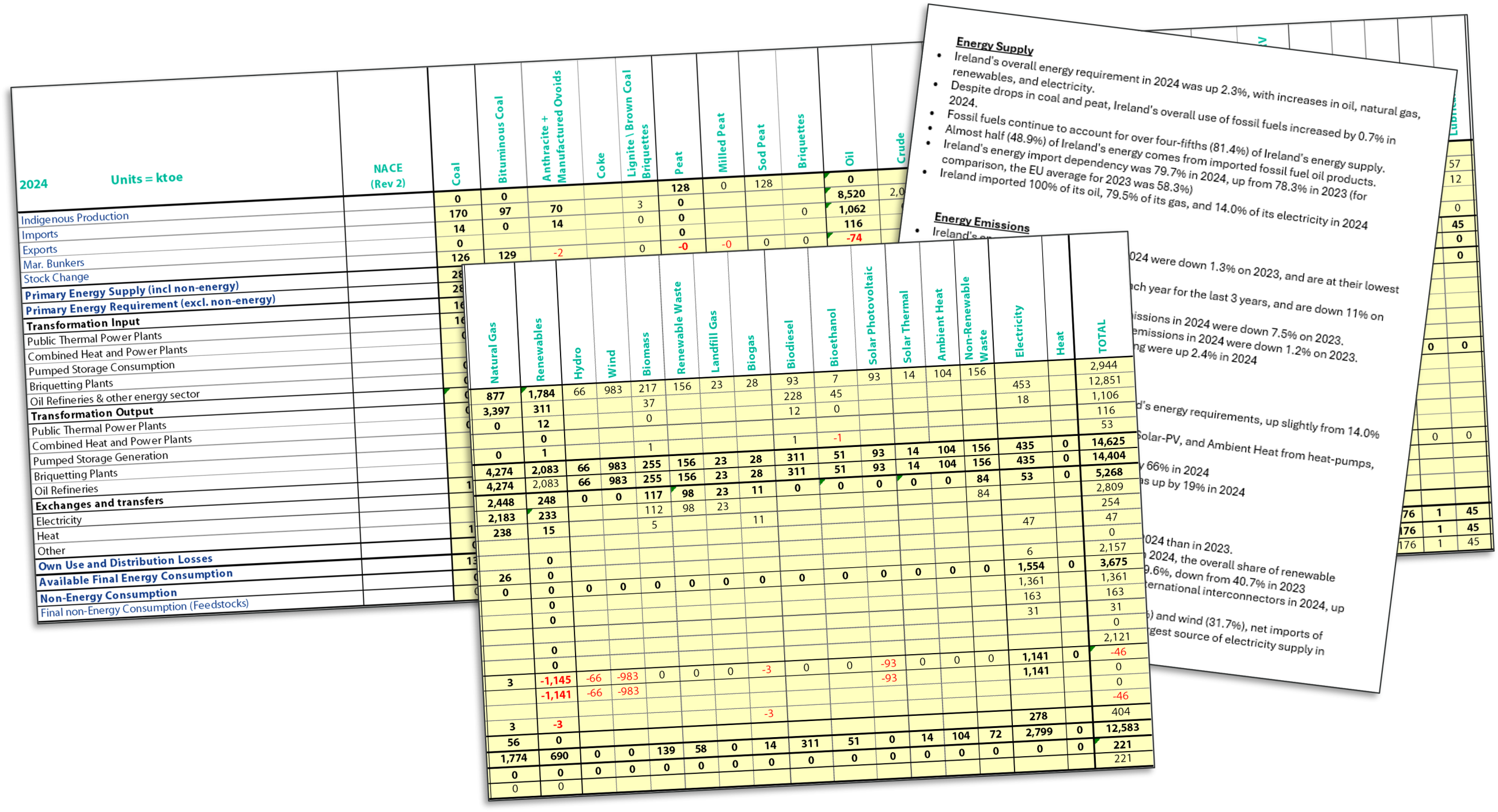
SEAI's National Energy Balance is the definitive source of data for the supply, transformation, and demand of energy in Ireland. It is produced by SEAI's Energy Statistics Team and is based on the direct surveying of hundreds of energy suppliers, as well as public administrative data from the Central Statistics Office (CSO), Environmental Protection Agency (EPA), Department of the Environment, Climate and Communications (DECC), Revenue Commissioners, and others.
On 19th May 2026, SEAI published the Interim National Energy Balance for 2025.
Energy Use
- Ireland’s energy use in 2025 was 2.2% lower than in 2024.
- Ireland’s fossil fuel use in 2025 was 4.7% lower than in 2024.
- Ireland’s coal use in 2025 was 45% lower than in 2024.
- Fossil fuels accounted for 79.2% of Ireland’s total energy use in 2025 – below 80% for the first time.
- Oil accounted for 47.3% of Ireland’s total energy use in 2025, mainly for transport and heating.
Energy-Related Emissions
- Energy-related emissions in 2025 fell below 30 MtCO₂eq for the first time on record.
- Ireland’s energy-related emissions in 2025 were 3.7% lower than in 2024.
- Energy-related emissions in 2025 were 19% below 2018 levels, the baseline year for the 2030 target of a 51% reduction in total greenhouse gas emissions.
- Electricity and transport emissions in 2025 were 8.4% and 1.6% lower than in 2024, respectively.
- SEAI provisionally estimates that the transport sector exceeded its sectoral emission ceiling in the 2021-2025 Carbon Budget by 8.0% or 4.3 MtCO₂eq.
- SEAI provisionally estimates that the electricity sector exceeded its sectoral emission ceiling in the 2021-2025 Carbon Budget by 1.1% or 0.4 MtCO₂eq.
Renewable Energy Supply
- Ireland’s renewable energy supply in 2025 was 6.8% higher than in 2024.
- 46.3% of 2025 renewable energy came from wind, 14.7% from biodiesel, and 11.9% from biomass.
- Renewable energy from solar PV, wind, biodiesel, ambient heat, renewable waste, biomass, and bioethanol all increased in 2025.
- Solar PV generated 1.65 TWh in 2025, 50% higher than in 2024 and 150% higher than in 2023.
- Large-scale solar farms accounted for two thirds of solar PV generation in 2025.
- Ambient heat (from heat pumps) in 2025 was 18% higher than in 2024 and 40% higher than in 2023.
- Wind generation in 2025 was 3.2% higher than in 2024.
- Ireland’s installed wind capacity in 2025 was 5.1GW, 15% below the 2025 CAP target of 6 GW.
Electricity Supply
- Ireland’s electricity supply in 2025 was 3.6% higher than in 2024 to meet electricity demand.
- The largest sources of electricity supply were gas (40.0%), wind (32.0%), and net imports (16.3%).
- Fossil fuels accounted for 42.0% of electricity supply in 2025.
- Renewable sources accounted for 40.9% of electricity supply in 2025.
- Net electricity imports across international interconnectors increased by 21% in 2025.
Energy Import Dependency
- Ireland imported 16.3% of its electricity supply in 2025.
- Ireland imported 82.3% of its gas supply in 2025.
- Ireland imports 100% of its oil and coal supplies.
- Ireland’s overall energy import dependency was 78.2% in 2025, down from 79.5% in 2024.
- The EU’s overall energy import dependency was 57.3% in 2024, with Ireland the fourth highest.
Sectoral energy demand breakdowns and TFEC-EED values for 2025 will be available in the Full National Energy Balance in Q3-2026.
Short Briefing on SEAI's 2025 Interim National Energy Balance
Learn more about the latest trends in Ireland’s energy supply and emissions in 2025. How much of our energy came from fossil fuels? What supplied our electricity? And how much of our energy needed to be imported?
Background & Timing of Releases
SEAI publishes the interim National Energy Balance annually in early May to provide details on the supply and transformation of Ireland's national energy portfolio in the previous year. SEAI publishes the full National Energy Balance annually in early September, which builds on the interim data by adding details on how Ireland's energy demand is apportioned over different sectors of the economy, e.g. the residential, commercial, and transport sectors.
In addition to providing insights into Ireland's energy landscape, the Energy Balance is a key input into the EPA's Greenhouse Gas (GHG) Inventory, and so directly informs emission results against our legally binding carbon budget, sectoral ceiling obligations. The Energy Balance is used to determine Ireland's results against national and European targets on renewable energy share (RES), and our targets mandated by the EU Energy Efficiency Directive (EED). Data from the Energy Balance is also used to satisfy Ireland's international reporting obligations to the International Energy Agency (IEA) and the European Commission under Regulation (EC) No 1099/2008 on Energy Statistics.
SEAI works to continuously improve the statistical methodology and coverage of the Energy Balance, balancing the availability of new data sources with the need for long-term stability for cross-year comparisons. We welcome feedback to [email protected].