From Red to Green: Reducing Energy Use at the Irish Blood Transfusion Service
The Irish Blood Transfusion Service is implementing a long-term Climate and Sustainability Strategy that seeks to reduce environmental impact while maintaining the safe and reliable provision of critical healthcare services.

The Irish Blood Transfusion Service (IBTS) is responsible for maintaining the supply of blood and blood products throughout Ireland. Its permanent facilities include the National Blood Centre, D’Olier Street, and Stillorgan Fixed Donation Clinics in Dublin, and IBTS Cork on St. Finbarr’s Hospital Campus. There are regional centres in Ardee, Carlow, Limerick, and Tuam, that operate mobile blood donation clinics across Ireland.
As part of its sustainability ambitions, the IBTS is implementing a long-term Climate and Sustainability Strategy that seeks to reduce environmental impact while maintaining the safe and reliable provision of critical healthcare services.
IBTS joined the SEAI Reduce Your Use (RYU) campaign during winter 2025/26 to help staff across multiple sites, build a culture of energy awareness, and deliver measurable savings. The initiative provides a practical, repeatable blueprint for public sector organisations at any stage of their sustainable energy journey.
First steps
Setting a baseline and targets
A key early step for IBTS was establishing a baseline (energy consumption data from winter 2024-25) and agreeing a realistic target for winter 2025-26 with senior management. They set a target of 5% reduction in energy use, which provided a clear goal and helped ensure organisational commitment from the outset through its participation in the RYU Campaign.
Staff training
IBTS recognised that lasting behavioural change requires a level of foundational learning and understanding amongst its people. Rather than launching directly into energy-saving messages, the organisation first focused on increasing staff awareness of sustainability, energy efficiency and climate actions through actions like its e-Learning Sustainability module.
Participation in the RYU Campaign also provides staff with access to SEAI’s Energy Academy, which offers free learning modules to improve their understanding of sustainable energy practices.
Rolling out the Reduce Your Use campaign
Effective Communication Channels
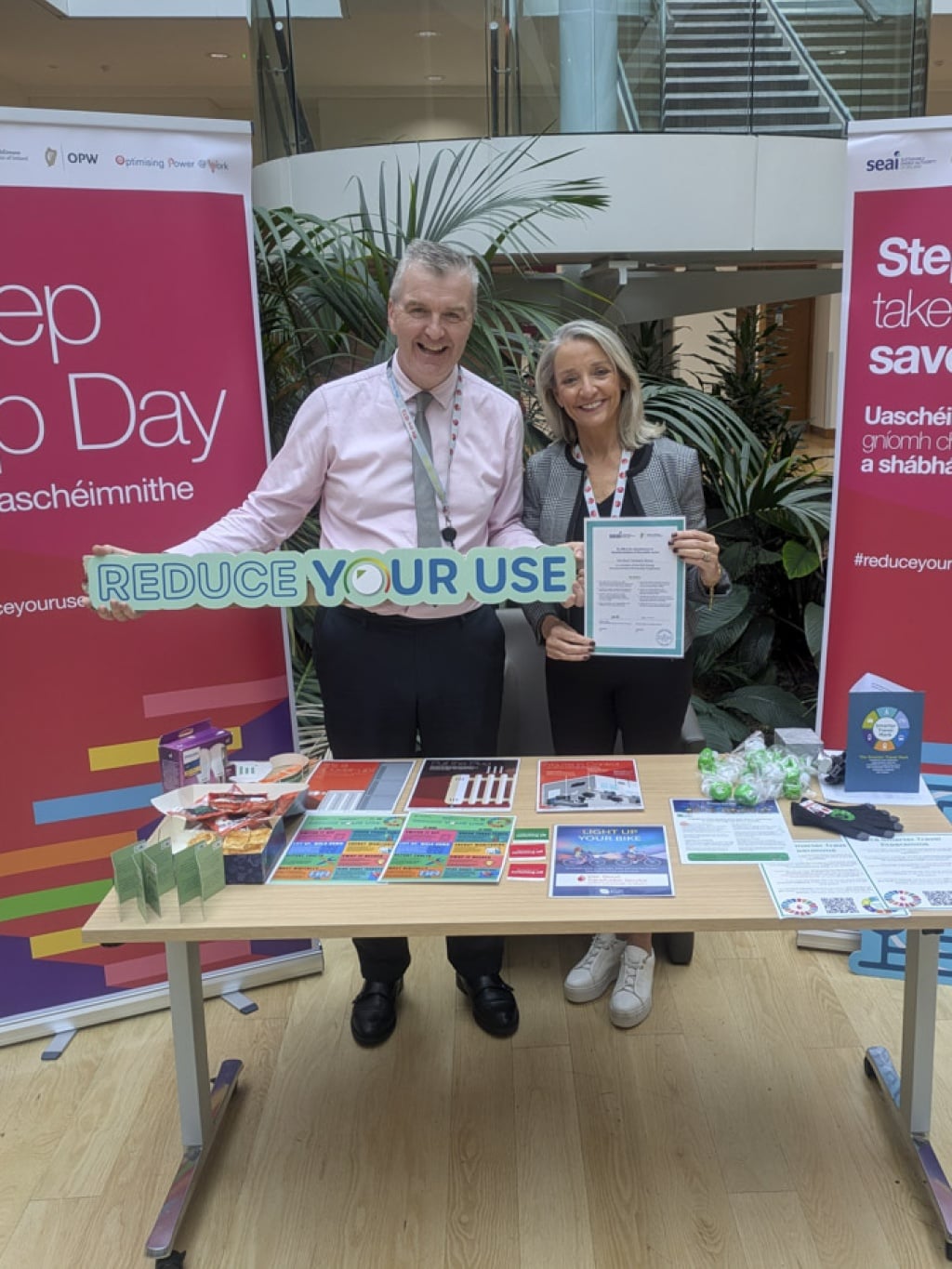
IBTS recognised the importance of communicating with its staff. It held an in-person launch day, which was supported by their CEO and Director of Finance. They hosted a staff briefing and provided regular staff newsletters.
IBTS shared progress through "IBTS Monthly Sustainability Updates" bulletins and targeted emails. One notable finding was a 32% reduction in staff leaving equipment turned on compared to the previous check, and a 41% reduction compared to the first assessment. Positive results like this were shared in the monthly updates, keeping the momentum alive.
SEAI Campaign Resources
The IBTS made extensive use of the SEAI campaign resources, such as:
- RYU Campaign Posters
- Email Template for Staff: that were adapted for IBTS focused impacts and topics
- Themed resources for Christmas, Easter etc.
- Guides for Awareness Days/Activities, for example a Steps Challenge. The TFI Smarter Travel/Active Travel programme is also a great place to start.
All of these can be found on our SEAI public sector platform, Energy Link.
Posters and communications were tailored to certain issues in specific buildings, such as equipment left on unnecessarily.
IBTS used the SEAI Register of Energy Management Measures to assess site performance through a “mini-audit” and identify opportunities for improvement at individual locations.
Campaign Initiatives
The IBTS implemented a variety of initiatives and staff activities throughout the campaign:
- Sustainability Drop-In Sessions - These sessions covered sustainability, energy efficiency and sustainable travel, while also giving staff an opportunity to ask questions and suggest improvements, and help turn the campaign into a two-way communication exercise.
- a Step-Up Day where staff were encouraged to take the stairs rather than the lift and
- Plant-room Tours to raise awareness around energy in the workplace.
Out-of-hours audits were carried out and provided a tangible view of staff engagement, particularly in buildings with high baseloads where smaller changes are harder to track.
Simple traffic-light stickers (available from SEAI) were used to highlight what should be turned off, what can be turned off, and what should be left on at the end of the day. These were paired with "Thanks for Switching Off" cards whenever a desk area was fully switched off. These simple, visual cues helped reinforce behaviour and showed staff that their actions are valued.

Procurement Initiatives
Beyond the materials, the RYU campaign was further embedded through activities such as procurement. The IBTS installed energy monitoring plugs to assess the canteen’s fridges. They were then replaced with more efficient models . The team used scoring metrics, such as energy management and carbon footprint, to make procurement decisions. This was done before purchasing cold storage equipment for labs, along with Green Public Procurement (GPP) and Socially Responsible Public Procurement (SRPP) guidance.
The Climate and Sustainability team also worked with the IBTS Labs personnel providing input on how to apply energy efficiency criteria to purchasing Lab equipment and supplies. As a result, lab staff were able to see through the greenwashing buzzwords to identify the genuinely energy efficient options.
The Results
The campaign exceeded expectations, with IBTS achieving a 6.7% reduction in energy use through savings of more than 320,000 kWh – surpassing its original 5% target – and avoiding 90 tonnes of CO₂ emissions.
The savings were equivalent to powering approximately 75 Irish homes for a year. Importantly, these savings were achieved while continuing to deliver critical healthcare services and without compromising the organisation's core mission of supplying blood and blood products.
What’s next?
The IBTS plans to carry out the following tasks for the 2026/2027 RYU Campaign:
- Use feedback from colleagues to influence how the organisation can launch, carry-out, and close-out the campaign.
- Launch new materials based on feedback.
- Connect the campaign to:
- The project pipeline for the Climate Action Roadmap to link with RYU so that people can engage with projects as they are completed.
- The structured energy management system.
- Reduce possible communications overload for staff and create more streams of alternative media e.g. videos
Join the Reduce Your Use campaign this year
The IBTS and many other public sector organisations have shown what's possible under RYU. The campaign runs from October to March each year and is a voluntary initiative. SEAI encourages the public sector to maintain or improve on savings made over previous winters. Participants commit to reducing energy use through staff engagement and no- or low-cost measures.
- Visit SEAI's Reduce Your Use webapge
- Register for the Reduce Your Use campaign
- Join the Community of Practice on Energy Link
- Access the resources and materials
- Start your own campaign – tailored to your organisation to continue your organisation's energy-saving journey.